Affiliate
Affiliate
What's the Best
Parkers Valuations
About What's the Best
What’s The Best is a comparison and review platform that helps people make informed decisions by providing clear, unbiased insights and recommendations on products and services across a range of categories.
My Role
I led in-depth research and analysis to evaluate the effectiveness of the existing feature structure, using data to identify opportunities for improvement. Based on these insights, I defined and drove the optimisation of the feature set, working within the constraints of the current user interface, to increase conversions and overall performance.
The Challenge
After conducting preliminary heuristic analysis using heatmaps and session recording software, we identified several usability issues within the existing product card feature that were negatively impacting user engagement.
These issues suggested that users were struggling to understand or interact with the component as intended, creating friction at key decision points. As a result, there was a clear risk of lost affiliate revenue due to reduced click-through and conversion rates.
Constraints
The product card was a shared, universal component used across multiple sites, meaning any updates needed to support a wide range of user groups and use cases. The solution therefore had to be flexible, allowing specific features to be enabled or disabled based on the site context and user journey.


Research
-
Led a heuristic evaluation of the existing product card to identify usability issues and quick-win improvements
-
Conducted competitor analysis to benchmark component patterns and market best practices
-
Synthesised internal and external insights to inform research direction
-
Designed and ran a preference test to understand user perceptions and expectations
-
Translated research findings into clear, actionable insights
-
Aligned stakeholders on user needs, technical constraints, and feasibility
-
Informed the creation of multiple design variations for a more effective, scalable product card component

Ideation
-
Partnered with product and engineering to understand technical constraints and data flows across internal systems and external partners
-
Incorporated technical and data considerations into early design thinking
-
Designed multiple component variants informed by feasibility and user needs
-
Leveraged existing design system components to ensure visual and interaction consistency
-
Reduced development effort by aligning designs with established UI patterns
-
Enabled scalable implementation of the component across multiple sites

Testing
-
Secured internal stakeholder approval for three proposed component variants
-
Planned and conducted usability testing across all variants
-
Recruited and tested with six users completing task-based scenarios focused on the new component
-
Included the existing component as a baseline to benchmark usability and compare performance
-
Analysed qualitative feedback and usability outcomes across all variants
-
Iterated and refined the final component based on user insights
-
Presented the validated, updated design to stakeholders for final approval and sign-off
Results
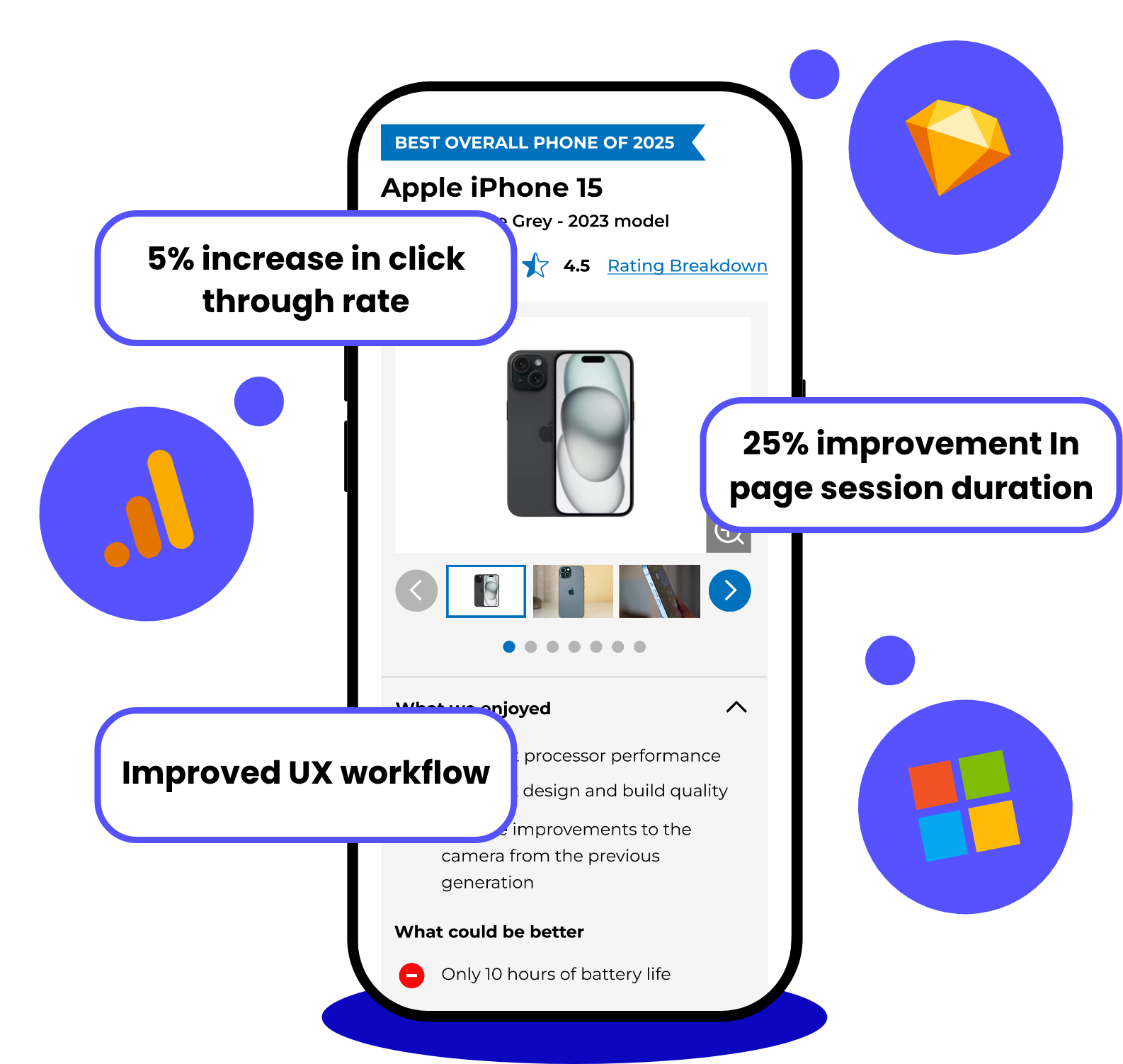
Following the launch of the redesigned product card component, we observed a 5% increase in click-through rate across primary calls to action and a 25% increase in page session duration, demonstrating measurable improvement in user engagement.
Learnings
A key insight from this release was the critical role of onboarding editorial teams to ensure the component was used effectively and aligned with user research. I led a workshop to introduce the component, showcase its variations, and clarify its intended usage across multiple sites. This approach not only supported strong adoption but also informed the creation of a new UX workflow for launching future components, embedding research-driven practices into the design process and enabling more consistent, scalable outcomes.

Results
Following the launch of the redesigned product card component, we observed a 5% increase in click-through rate across primary calls to action and a 25% increase in page session duration, demonstrating measurable improvement in user engagement.
Learnings
A key insight from this release was the critical role of onboarding editorial teams to ensure the component was used effectively and aligned with user research. I led a workshop to introduce the component, showcase its variations, and clarify its intended usage across multiple sites. This approach not only supported strong adoption but also informed the creation of a new UX workflow for launching future components, embedding research-driven practices into the design process and enabling more consistent, scalable outcomes.